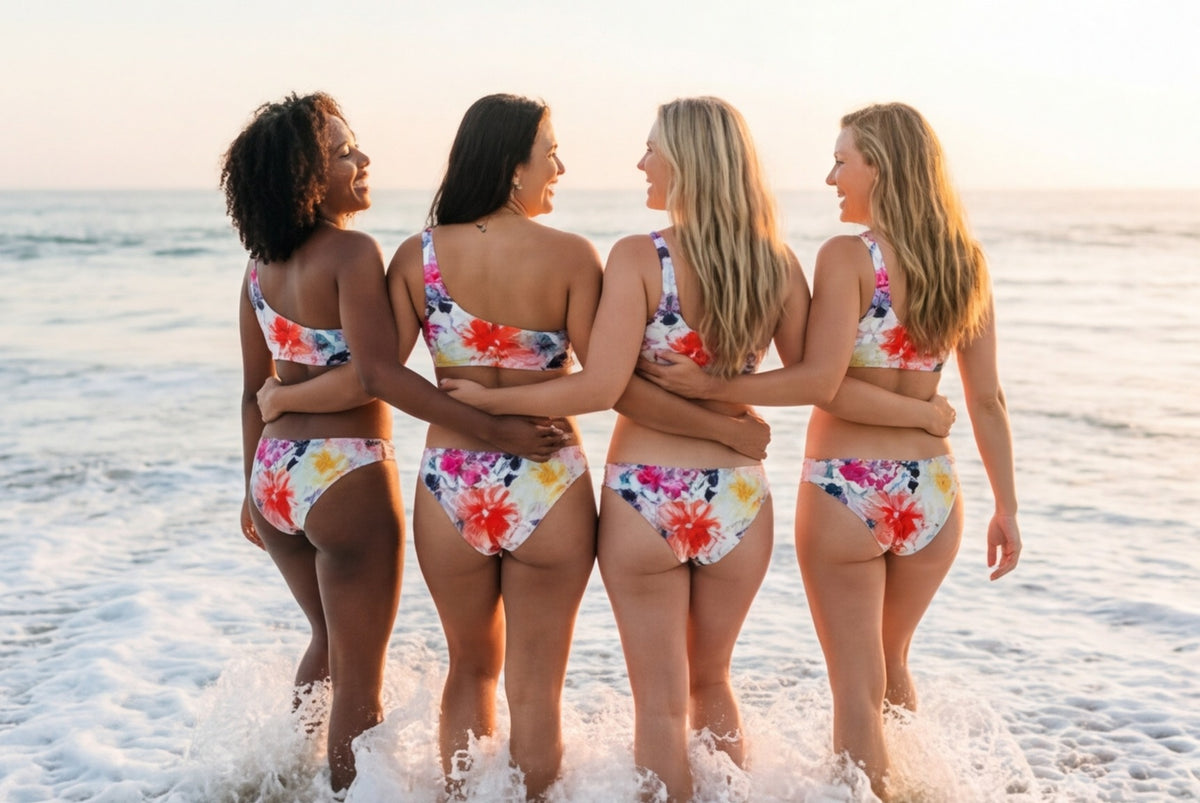


Luxury Swimwear for the Body She Lives In
Why We All Know This Search Takes Too Long
Most of us have stood in a dressing room at some point in our lives, holding a swimsuit that looked beautiful on the hanger and felt like a small betrayal on our body—the cups gap. The straps slip, the band rolls. We pull, adjust, and try a size up, then a size down, and somehow neither works. We leave without buying anything, or we settle, and we spend the whole summer tugging at something that was never really built for us.
Many of us know this feeling. Our bodies have changed through perimenopause, our standards are clearer now, and we know exactly what we need from a suit.
The Sample Size Problem
The structural reason this search has been so hard is straightforward: the swimwear industry was built to a sample size and called it standard. Grading up from a size 6 pattern does not produce a suit that fits a size 14 or 16 body with a D cup or larger. It produces a larger version of a suit designed for a different body entirely. The cups are too shallow. The straps are too narrow. The band has no real anchoring power. The result is a garment that looks like swimwear but performs like a suggestion.
For women experiencing perimenopause, the fit gap tends to grow. Breast tissue softens, weight shifts, and suddenly, that swimsuit which fit perfectly last summer becomes too loose by midday. These changes are not complaints; they are natural biomechanical realities. Good design should help accommodate them, but for many years, most mainstream swimwear didn't quite do so.
The good news is that the market is finally catching up to her needs. According to Allied Market Research, the global women's sports and swimwear market is expected to reach $148.32 billion by 2031, with a steady growth rate of 6.4% CAGR. The premium and performance segments are leading the way, driven by the woman who has been underserved for so many years. Her purchasing power is significant, and her expectations are shaping the future of design.
According to Fast Company, women over 40 accounted for 56% of all clothing purchases in 2022, with their spending increasing while spending among those under 40 declined. The industry is catching up to a reality she has lived for years.
What Most of Us Miss About How Good Swimwear Is Actually Built
Swimwear that fits a fuller bust with real support is engineered the same way a well-made bra is engineered. Most of us understand this intuitively from our own wardrobes, but the connection rarely gets made explicit in how we shop for swim.
The Bra Architecture Analogy
Think about what makes a bra work for a larger bust. Cup projection, meaning the depth and shape of the cup relative to the breast volume. Band width and anchor points, which distribute weight across the torso rather than loading it onto the shoulders. Strap placement, set wide enough to stay on the shoulder without digging. Underwire geometry, curved to follow the breast root rather than sit flat against the chest. These are not comfort preferences. They are structural requirements.

A well-engineered swimsuit top uses the same principles. The difference is that swimwear fabrics stretch in water, bands get wet and lose friction, and the garment has to perform through movement, not just standing still. This is why cup grading matters so much. A suit graded from a single pattern without cup calibration will lose its shape the moment it gets wet. The cups collapse forward. The band rides up. The support that felt adequate in the fitting room disappears in the water.
Research published via Lingerie Briefs, citing a Bravissimo swim survey, found that 71% of women who wear a D cup or above said support is an important function of swimwear, rising to 85% for F cup and above. These women are not asking for something unusual. They are asking for what good design already knows how to deliver.
A 2022 cross-sectional survey found that 27.4% of respondents said lack of breast support prevented them from being active or exercising, with breast size significantly associated with this barrier. Swimwear that fails at support does not just cause discomfort. It changes what women choose to do with their bodies.
Where Premium Design Diverges From Fast Fashion
The difference between a $30 swimsuit and a $200 one is not the print or the brand name. It is the construction sequence. Fast-fashion swimwear starts with a trend, selects a fabric, and cuts to a size range. Premium swimwear starts with body geometry, selects a fabric that will maintain its structure under tension and in water, and builds the support architecture before making aesthetic decisions.
Fabric performance is part of this architecture. Chlorine-resistant materials hold their elasticity across a full season of pool use. UPF-rated fabrics protect skin without requiring a cover-up over every swim. Sustainable fabrics made from recycled fibers can meet both standards without compromising hand feel or stretch recovery. These are not marketing features. They are performance specifications that determine whether a suit still fits and supports in September the way it did in June.
The thesis here is direct: swimwear designed around technical fit, bust support, and real body proportions is the standard midlife women have always deserved. A growing category of artisan and premium brands is finally building to that standard.
Most of us have spent years buying suits that worked around our bodies. The shift happening now is designers who start with our bodies and build the suit from there.
When I Started Designing for the Body I Actually Have
I founded Ir Al Sol because I was searching for something that I couldn't find. As a nurse and a proud Colombian woman, I brought two perspectives to this venture: a clinical understanding of how bodies change and what genuine support involves, along with a heartfelt respect for the craft traditions of unique swimwear, where fit and craftsmanship have always been cherished.
The Slow Season and the Ritual
The Ir Al Sol woman does not rush her beach morning. She has her SPF ritual, her preferred time in the sun, her sense of what a good day at the water actually feels like. She wants a suit that matches that intentionality. One that she chose carefully, cares for properly, and returns to season after season because it still fits and still holds its color.

This is the opposite of the cycle most of us have been in: buying a new suit every summer because last year's faded, stretched, or simply stopped working. That cycle is expensive and unsatisfying. A well-made artisan suit, cared for correctly, breaks it entirely.
What We Look for Now, and Why It Changes Everything
Once you know what good construction looks like, shopping changes. You stop evaluating swimwear by how it looks on a model and start evaluating it by how it is built. These are the things worth looking for.
The Investment Wardrobe Standard Applied to Swim
Most of us apply an investment logic to other parts of our wardrobes. We know that one well-made coat, chosen carefully and maintained properly, outperforms five cheaper ones over five years. The same logic applies to swimwear, and the math is even clearer because the performance requirements are so specific.
A chlorine-resistant, UPF-rated suit in a premium sustainable fabric holds its elasticity, color, and shape through a full season of regular use. A fast-fashion suit made from a standard nylon blend may fade, stretch out, or lose its support structure within weeks of regular exposure to pool or ocean water. The cost-per-wear calculation is not close.
What the Construction Checklist Actually Looks Like
For the Curves-First Shopper, the checklist for a well-made suit covers a few specific things:
- Cup grading calibrated to bust size, not just garment size. The cup depth and projection should increase proportionally with size, rather than simply scaling the entire pattern up.
- Band construction with real anchoring power. A wider band in a fabric with controlled stretch and recovery keeps the suit in place during movement and water exposure. A narrow band in a high-stretch fabric will migrate.
- Strap placement and width matched to bust weight. Wider straps set at a position that follows the natural shoulder line distribute load without digging. Thin straps on a heavier bust transfer all the weight to two narrow points.
- Fabric with chlorine resistance and stretch recovery. This determines whether the suit still fits in August the way it did in June.
- Seaming that follows body curves rather than straight-line construction. Curved seams create three-dimensional shape. Straight seams flatten it.
These are not luxury specifications. They are basic engineering requirements for a suit that actually works. The fact that they have been treated as premium features for so long says more about the industry's baseline than about the complexity of the ask.
Coverage, Confidence, and the High-Leg Bikini Question
Coverage is a personal decision, and it should be made on the wearer's terms, not dictated by what the market happens to be producing this season. Some of us want a high-leg bikini that elongates the legs and makes us feel confident and free. Some of us want a one-piece with structural support and a neckline that works for our lifestyle. Some of us want both, depending on the day.
Good design makes all of these possible without compromise. A high-leg bikini bottom can be cut to flatter a fuller hip. A one-piece can have a built-in bra structure that genuinely supports a D cup or larger. A tankini can have a fitted top with real cup construction rather than a loose shelf bra that provides the appearance of support without the function.
The growing focus on swimwear engineering for fuller busts reflects a design shift toward specialized construction, including underwire placement, wide strap geometry, and side boning, rather than simply offering extended sizing in standard patterns. These are different things. Extended sizing in a standard pattern produces a larger version of a suit designed for a different body type. Specialized construction gives a suit designed for the body it will actually be worn on.
Swimwear that fits your actual body, with support for a fuller bust, curves, and real life, is what good design looks like. It was never a luxury. It was always the standard.
The Wellness-First Woman and the Conscious Traveler
For the woman who thinks carefully about what she puts on her skin and in her body, fabric matters beyond aesthetics. Sustainable fabrics made from recycled materials reduce environmental impact without sacrificing performance. UPF-rated fabrics provide measurable sun protection, which matters for anyone with a consistent SPF ritual who wants her swimwear to be part of that protection, not a gap in it.

For the woman who travels to resort destinations and wants a wardrobe that moves from beach to lunch to an afternoon walk without requiring a full outfit change, the design versatility of a well-made suit matters as much as its technical performance. Beach-to-street styling is a real use case, and it requires a suit with enough structural integrity to look intentional outside the water, not just functional in it.
These are the details that make a suit worth its price. Not the label. The construction, fabric, fit, and longevity.