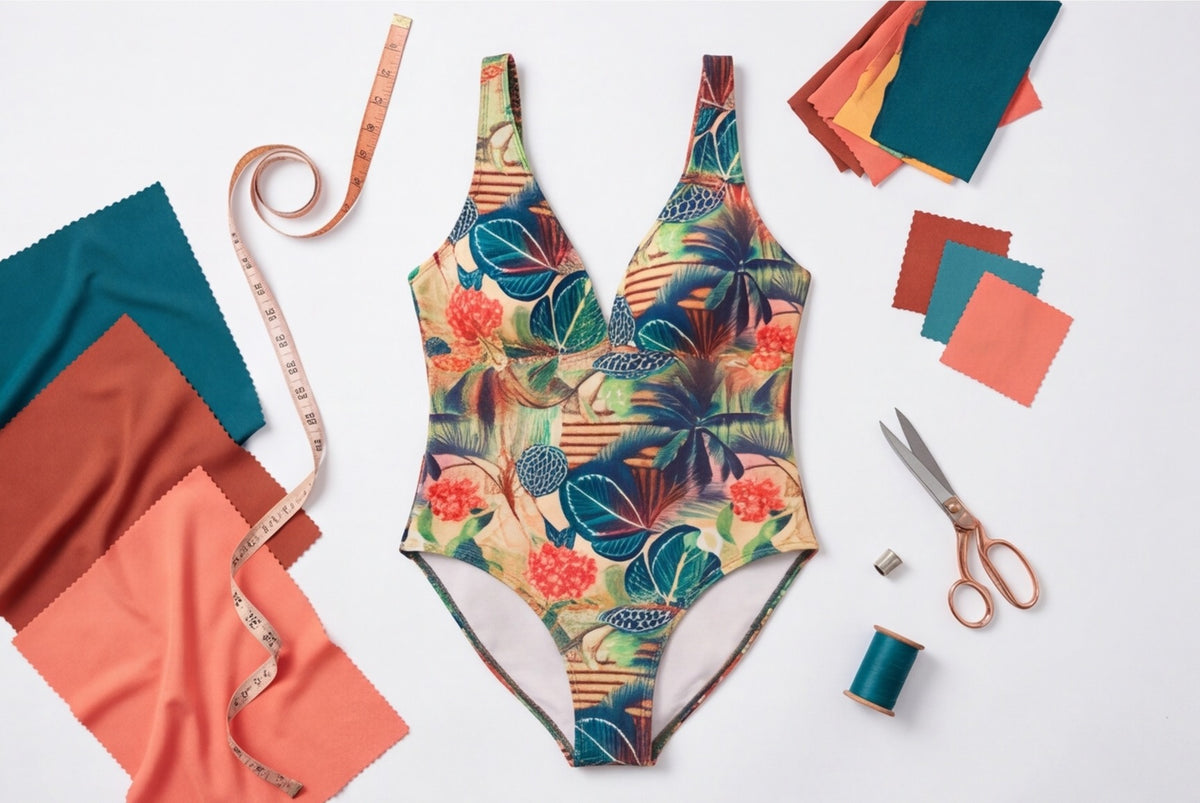

Article: Custom Bikini Sizing: Why Suit Behavior Beats a Tape Measure

Custom Bikini Sizing: Why Suit Behavior Beats a Tape Measure
Key Takeaways
- Roughly 49% to 67% of women wear different sizes on top and bottom, according to research cited by Missing Perspectives and Curated Sense, which is why matched bikini sets force a fit compromise.
- Ir Al Sol cuts a custom bikini top by band and cup size and the bottom separately from XS to XL, both included in one $295 order with no upcharge for a larger cup.
- Fit is captured through five questions about how current suits behave, such as gapping or riding up, rather than a tape measure, reflecting how little static measurements predict fit.
- A study of 677 people found only about 9% keep consistent bust, waist, and hip proportions, per research published via the National Institutes of Health, explaining why one size number rarely fits two halves of a set.
- Each custom bikini takes four to six weeks from order to door, is cut in Florida only after ordering, and includes one free adjustment with shipping covered both ways.
Most swimwear sizing still asks one question: what size are you? That question assumes a single number can describe a chest, a rib cage, a waist, and a hip all at once. Anyone who has stood in a fitting room holding a medium top and a large bottom already knows how badly that assumption holds up.
What's changing, slowly, is the sizing question itself. Instead of asking a static number, a smarter process asks how a suit actually behaves on a body already. Does the band ride up when you raise your arms? Does the bottom gap at the leg? Does the top dig in under the wire? Those are behavior questions, not measurements, and they turn out to predict fit far better than a tape measure ever did.
That shift, from passive sizing to active fit information, is the quiet mechanism behind every custom bikini worth the name. It's also where we start, because before we talk about band and cup or turnaround time, it helps to understand why the old system was built to fail a lot of us from the beginning.
The Two-Size Problem Every Bikini Shopper Knows
Most women are not the same size on top as they are on the bottom, and a matched bikini set forces a choice about which half to disappoint. You size up for the bust and the bottom gaps at the hip. You size down for the waist and the top won't close around the band. Neither suit is wrong exactly. They're both just built to one number that was never going to describe two different parts of one body.
This isn't a rare mismatch. Nearly half of women, around 49% according to research cited by Missing Perspectives, wear different sizes on top and bottom. A separate swim-sizing study put the figure even higher, finding that roughly 67% of women wear different sizes on their bikini top and bottom, according to Curated Sense's review of swim sizing data. Either way, the mismatch is closer to the norm than the exception. We hear a version of the same pattern constantly: someone has bought two separate bikinis before, one chosen for the band and cup, one chosen for the hip and waist, just to end up with a single set that actually stays on. That simply reflects the fit, not the person. It's what happens when a single size number is asked to do a job it was never built for.
A custom bikini solves this at the construction level, right where it's built. At Ir Al Sol, the top is cut by band and cup size and the bottom is cut separately by size, XS through XL, and both are included in one order at no extra cost. You are not choosing which half of yourself to shortchange. You're ordering two correctly sized pieces that happen to arrive as one set.
What Makes a Custom Bikini Actually Custom
A custom bikini is only actually custom if nothing is cut before the order exists. That's the line that separates true made-to-order construction from a stock pattern with more size options printed on the chart. Extended size ranges help, but they're still built from one shape scaled up or down. A cup letter and a band number are a different kind of information entirely, and they require a different kind of pattern.
 SHOPTHE LOOK
The "Two Sides of One Suit" Idea
Think of a bikini top and bottom as two separate construction problems being solved together inside one order, not one problem solved twice with the same math. The top has to answer to a bra size: band and cup. The bottom has to answer to hip, waist, and leg opening. Solving both at once, with two separate size inputs, is what "custom" is supposed to mean.
A chest measurement is not a bra size, and a hip measurement is not a bottom size. Treating them as the same kind of number is exactly how matched sets end up wrong twice over instead of right once. This isn't unique to any one brand's chart. Research on sizing consistency backs up how unreliable a single number is across the board: a study measuring more than 1,000 garments from 50 brands found an average size variance of 4.2 centimeters within the same brand and category, a gap the researchers behind Tellar's original research called catastrophic for fit. A related analysis of 1,500 brand size charts found bust measurements for the same labeled size ranging across a full 4-inch spread, according to Tellar's size chart review. If the label itself is that unstable, sizing to it was never going to be precise.
None of that variance is really about bodies changing shape overnight. It's the sizing system, built decades ago around a single averaged shape, showing its age. Nothing is drawn or cut until an order comes in, and the same fabric is never cut in the same shape twice, so the suit that lands in your hands doesn't exist anywhere else.
Answering Five Questions Instead of Reaching for a Tape Measure
Fit at Ir Al Sol is captured through five short questions about how suits currently behave on your body, using your own words. That's the active, data-capture approach: instead of asking for static inches, we ask what your current suits actually do when you move, sit, or reach.
What the Questions Actually Ask
The questions cover things like whether a bottom currently gaps at the leg, whether a band rides up under your arms, whether an underwire digs in at the center, and where a one-piece tends to ride up or bunch. Those answers describe fit failure in the exact places it happens, which is more useful than a number that describes a body in isolation, disconnected from any actual suit.
 SHOPTHE LOOK
This approach matters because bodies don't vary along one axis. A 2025 review of measurement data found that only about 9% of people maintain consistent proportional relationships across bust, waist, and hip measurements, while the remaining 91% show real variation across those three points, according to research published via the National Institutes of Health. A tape measure gives you three numbers. It doesn't tell you how those numbers relate to each other on your particular body, and that relationship is exactly what determines whether a suit gaps, digs, or slides.
Two adjustments come up often enough that we want to name them directly, because neither one is treated as a special request:
- A larger cup size never costs more. Band and cup are simply what we cut to, the same as any other size input.
- A long torso is cut longer between the bust point and the leg opening on request, which is the actual fix for a one-piece or bottom that rides up. The body isn't cut wrong. The suit just needed to be cut longer in that one distance.
Sizing struggles aren't limited to any one part of the body. Research from QVC found that a quarter of women find it difficult to find swimwear that fits correctly in their size at all, and swimwear consistently ranks among the hardest categories to size correctly online, with Popsy Clothing's Fit Fix Report putting the figure at roughly 26% of online shoppers struggling specifically with swim sizing. Answering behavior questions instead of taking a measurement is our way of working around that difficulty rather than asking you to solve it yourself with a tape measure and a size chart that was already unreliable to begin with.
From Order to Doorstep: Timeline, Fit Guarantee, and What Makes It Yours Alone
A custom bikini from Ir Al Sol takes four to six weeks from order to door, costs $295, and comes with one free adjustment with shipping covered both ways. Those numbers are the whole process in shorthand: nothing is rushed, nothing is generic, and nothing is final until it fits.
What Happens During Those Four to Six Weeks
Once your band and cup size, bottom size, and fit answers come in, the suit is drawn and cut in Florida. It doesn't exist as inventory before that. One piece of fabric is cut into one shape for one order, and that same fabric is never cut into the same shape again, which is what makes the finished suit one of one rather than one of a production run. If it needs a small correction once it arrives, that's what the free adjustment is for, and we cover shipping in both directions so fixing it doesn't cost you anything extra.
 SHOPTHE LOOK
This is also where cost tends to come up. A custom bikini generally costs more than an off-the-rack matched set because it's cut once, for one person, instead of produced in bulk against an averaged size chart. At $295, or $395 for a reversible piece, you're paying for a top and bottom sized independently, a build process that starts only after you order, and a fabric that won't turn up on anyone else. That's a different cost structure than mass production, reflecting the value of that work.
Reversible Construction, as a Bonus Rather Than the Point
Most pieces can be made reversible for $395, with both faces finished so one suit gives you two prints to wear. It's worth mentioning because it's practical for travel and packing light, but it isn't the headline. The headline is still the fit: band and cup on top, XS to XL on the bottom, cut after you order, never repeated.
Evelin, the woman behind Ir Al Sol, spent her childhood summers on the Colombian coast, and those summers gave the brand its name: toward the sun. Every suit is still drawn, cut, and sewn by hand in Florida, by Evelin and a small group of freelance sewers, after your order comes in. A matched set makes you choose which half to disappoint. A custom bikini, cut in both of your actual sizes, doesn't ask you to choose at all.