
Best Swimwear for Large Bust: How Support Is Built, Sized and Tested
Key Takeaways
- Support comes mostly from the band: in a bra, experts put 80% to 90% of a bust's weight on it and only 10-20% on the straps, and the same logic carries over to swim tops.
- A chest measurement ignores cup volume, and sizing up in a small-band top raises the cup while loosening the band that does the work.
- Convert a bra size to a swim top by band first, then cup, and check sister sizes before accepting a larger generic size.
- Support needs differ by activity: laps need a secure band and straps, whereas lounging allows a softer structure.
- A top cut by band and cup and a bottom cut XS to XL removes the compromise of a matched set.
The best swimwear for a large bust is built, not ranked: a wide band, shaped cups and well-placed straps, sized by band and cup. This guide explains how each part creates support, how to convert a bra size to a swim top, and which features suit which activity.
Why a Chest Measurement or Sizing Up Fails a Fuller Bust
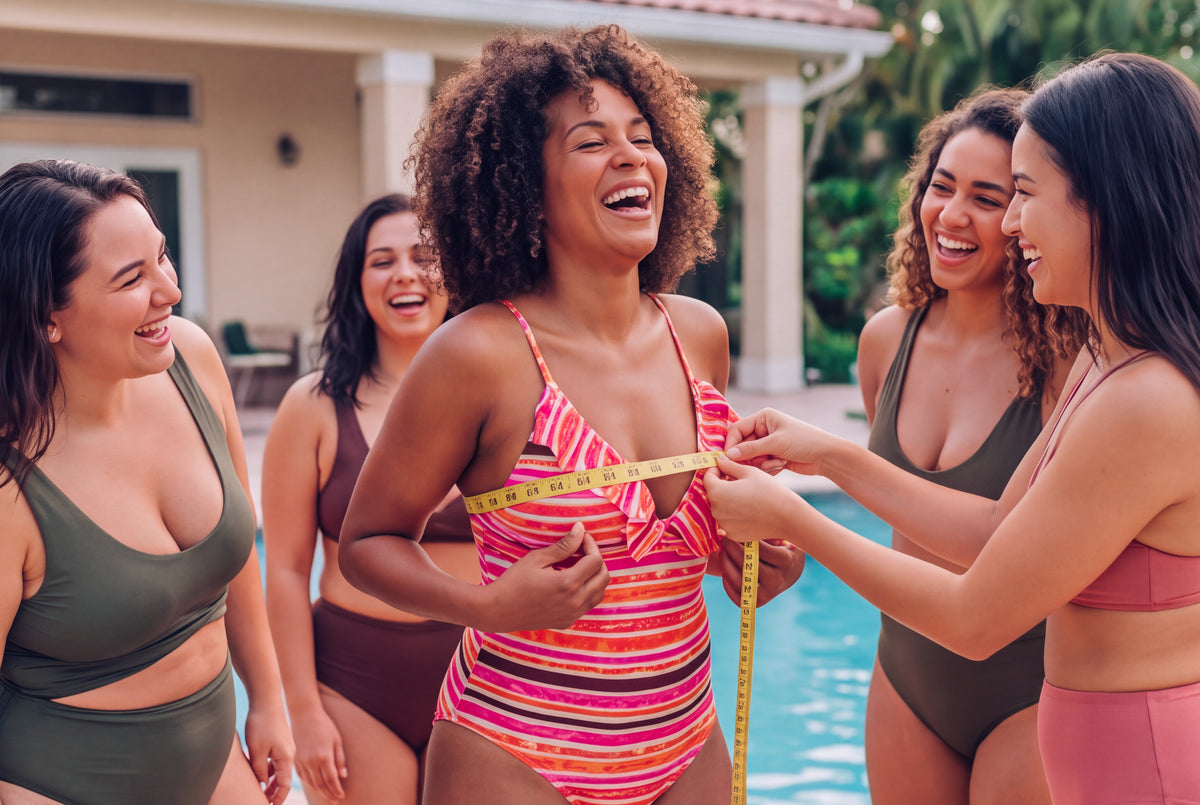
Small, medium and large labels guess at the bust. A chest measurement captures the ribcage and maybe the fullest point, but it says nothing about cup volume, so the top can fit one number and still gape, spill or slip.
A Chest Measurement Is Like Ordering a Bra by One Number
Picture buying a bra with a single number and no cup letter. That is what a standard swim top asks of a fuller bust. Sizing is built around an average nobody actually is, so the failure belongs to the sizing system, not to the body wearing the suit.
Why Sizing Up Loosens the Band
The usual workaround is to buy the next size up for cup room. In a small-band top, that raises the cup and loosens the band at the same time. The band is the part doing the work, so the support she was trying to add goes missing.
According to TODAY, experts recommend that 80% to 90% of a bust's weight should be carried by a bra's band, with only 10-20% on the straps, and the same logic carries over to swim tops. A larger generic size can leave the band too loose to carry that share, so the straps take over and dig in.
Returns tell the same story. ReturnLogic reports that Statista data puts online swimwear return rates as high as 40%, attributed largely to fit and style preferences. When the top is sized by band and cup, with the bottom sized separately, the guesswork that drives those returns shrinks.
How to Convert Your Bra Size to a Swim Top Size
Start with the band number from your best-fitting bra, then match the cup letter. Swim fabric stretches and wet fabric relaxes further, so many people land on the same band they wear in a bra and a cup that is true to their bra.
Band First, Then Cup
- Take the band from a bra that fits well, not from a tape measure alone.
- Keep the cup letter that goes with that band. The same letter holds different volume on different bands, so changing one number changes the other.
- If the band feels loose in water, try the next band down with the next cup up. These are sister sizes and hold the same cup volume.
- Check the lettering. UK and US charts match through DD, then diverge: UK goes DD, E, F, FF, G, GG, H, whereas many US charts go DD, DDD or F, G, H.
- Allow for wet fabric, which can loosen the band a little once the suit is in the water.
A Quick Sister-Size Reference
| Bra size | Sister size down (smaller band) | Sister size up (larger band) |
|---|---|---|
| 34D | 32DD | 36C |
| 36DD | 34E (UK DD to E) | 38D |
| 38G (UK) | 36GG | 40FF |
Cup letters shift between UK and US charts above DD, so check which chart a maker uses before relying on a letter. For G cups and above, a stretch top labeled medium or large rarely substitutes for a top with a stated cup.
What Makes a Swim Top Supportive: Bands, Cups, Straps and Underwire
A supportive swim top has a wide underband, cups with real shape, and straps that steady the top rather than carry it. Yahoo puts it this way: the best support comes from the band.
Bands and Cups
A wide underband spreads pressure around the ribcage and resists riding up. Cups can be underwire, molded foam or power mesh lining. Underwire gives the most defined lift and holds shape in water. Molded cups give shape without wire. Power mesh adds firm stretch support, which suits lighter coverage.
Research on sports bras points the same direction. A 2020 study in Ergonomics tested 98 sports bras on about 77 women and found breast-movement reduction ranging from 36% to 74%, with encapsulation style, padded cups, an adjustable underband and a high neck drop among the features that explained part of the difference. Swim tops are a different garment, but the construction logic carries over.
Straps and the D+ Friendly Label
Wide, adjustable straps placed closer to the shoulder points steady a fuller cup, whereas thin straps set wide tend to slide and dig. A 2016 plus-size swimwear study in Fashion Practice found participants unhappy with straps falling off, constant adjusting and inadequate bust support.
A top labeled D+ friendly is usually a stretch size with a cup that expands. A cup-sized top has a stated band and cup and a pattern cut for that volume. They are different garments.
Why Reversible Tops Often Have No Built-In Bra
A reversible top has two finished faces, so there is no room for a molded lining on one side. Support then comes from the band, ties and cut instead. Choose reversible for a fuller bust only when the pattern is cut by band and cup.
Bikini, Tankini or One-Piece: Matching the Style to Your Bust
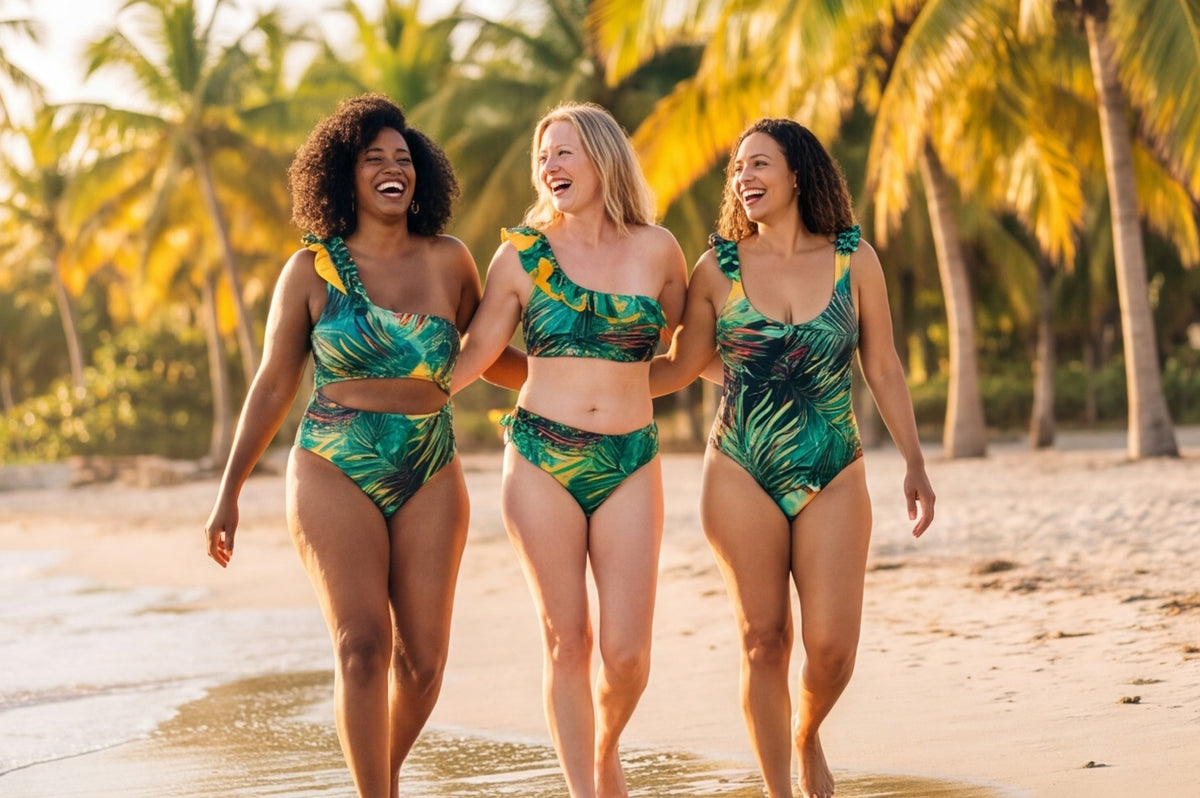
Halter, balconette, bra-style and high-neck tops hold a fuller cup best, whereas deep plunges and thin string styles tend to feel unsupported. One-pieces and tankinis work when the length between bust and leg matches the torso.
Top Styles Compared
| Style | How it holds | Watch for |
|---|---|---|
| Halter | Neck ties take strap load and are adjustable | Neck strain if the band is loose |
| Balconette | Cut across the cup for lift and a wide, stable band | Needs a true cup size |
| Bra-style | Closest to a bra, with a back closure and underwire option | Less give in sizing |
| High-neck | More coverage and less bounce | Can feel warm and needs enough cup depth |
| Deep plunge | Open centre gives little support | Shifts with movement |
Our halter tops and high-neck crop tops are both cut to order by band and cup.
Tankini and One-Piece
A tankini covers the midsection and suits swimmers who want coverage, but the hem needs to sit where the torso ends. A one-piece spreads support across the body, and a supportive one-piece for a large bust needs a structured bust and straps with some width.
 SHOPTHE LOOK
One-pieces ride up when they are cut too short between bust and leg. A long torso pulls the fabric upward, then the straps lift and the cups slide. The remedy is more length in the suit. Our one-piece collection can be cut longer between bust and leg on request.
Choosing Support by Activity: Laps, Waves, Beach Volleyball or a Day on the Sand
More movement needs more band, more strap security and less open neckline. Lounging allows softer structure, whereas laps, waves and volleyball call for a firm band and secure straps. The best swimwear for a large bust is the one matched to what you do in it.
An Activity-to-Feature List
- Lap swimming: wide underband, adjustable crossback or wide straps, a high neck drop, chlorine-resistant fabric.
- Waves and surf: a back that ties or closes firmly, structured cups, no deep plunge, a snug fit that will not wash loose.
- Beach volleyball and paddleboarding: underwire or molded cups, wide straps, a stable band, secure bottoms.
- Playing with kids: full coverage cups and a halter or high neck that stays put when you bend.
- A day on the sand: comfort first, so a lighter structure and softer band work, with room to adjust straps.
Is a Bikini Top With a Rash Guard Enough?
A rash guard adds compression and coverage, and it can reduce bounce when worn over a well-sized top. It cannot replace a band that is too loose underneath. If the bikini slides, the rash guard will carry the problem with it.
Yahoo describes the goal: a supportive swimsuit should help you feel secure, confident and comfortable whether you are swimming, lounging or being active. Match the build to the day and that goal gets easier to reach.
A Different Size on Top and Bottom, With Any Frame
Most women are not the same size on top as on the bottom, and a matched set asks them to choose which half to disappoint. Buying the top and bottom separately only works when the top is truly sized by band and cup and the bottom by its own size.
Three Common Proportions
- Fuller bust with a smaller bottom: the top needs a larger cup, while the bottom stays in its own size.
- Plus-size with a large bust: the band and cup both need real range, since a stretch size covers volume but not support.
- Petite frame with large cups: a narrower band with a deeper cup, which sister sizing often handles best.
Hypebae notes that fuller-bust coverage is increasingly framed around bra solutions, wider size availability, and fit for different proportions, including petite and plus-size fuller busts.
Why Most Separates Only Half-Solve It
Many mix-and-match separates still run the top in letters and numbers that follow the bottom. If the top is a small, medium or large, you can pick a different bottom but not a different cup. Some brands answer this with two stretch sizes covering a wide range, which Inside Retail US describes as an active direction. That helps with convenience, but it does not give a stated band and cup.
A cut-to-order top by band and cup and a bottom by XS to XL treats each half as its own size. Nobody has to pick which half to disappoint.
What to Check Before You Order: Fit Tests, Returns and Wet Wear
Check gape, band ride-up, strap dig and spill, then run a jump test. Swimsuits relax in water and age in chlorine and salt, so a top that feels borderline dry may loosen once wet.
A Pre-Order Checklist
- Gape: the top edge of the cup should sit flat against the chest.
- Band ride-up: raise your arms, and the band should stay level.
- Strap dig: straps should rest without leaving deep marks.
- Spill: no flesh should escape above, below or at the sides of the cup.
- Jump test: hop several times and bend forward. The top should move with you rather than away from you.
Wet Wear and Returns
Wet fabric stretches, so the band can loosen a little in the water. Chlorine and salt wear down elastic and underwire over a season, which is why rinsing after each swim and letting a suit dry flat helps it last. In the same study, participants named weak, non-chlorine-resistant fabric as a complaint.
 SHOPTHE LOOK
Before buying, read the return terms. Many swimwear policies exclude worn suits, so a return may not be an option. An adjustment policy is worth more than a return window, because the suit is changed to fit rather than sent back.
Yahoo Style reports a test of more than 70 swimsuits from 21 brands that produced over 300 points of feedback on fit and support for larger cups. The pattern in that feedback matches the checklist above: the details of fit matter more than the label.
Getting the Best Swimwear for a Large Bust Made to Your Size
A suit cut to order answers the fit problem directly: the top is cut by band and cup, the bottom by XS to XL, and the sizing system stops guessing. A larger cup never costs more, and nothing is cut until you order.
What Cut to Order Changes
We ask five short questions about how suits behave on you instead of asking for a tape measure. The top follows your band and cup, and the bottom follows its own size, with both included at no extra cost. A long torso can be cut longer between bust and leg on request, so a one-piece has room to stay put.
Each suit is drawn, cut and sewn in Florida after the order, and it takes four to six weeks from order to door with tracking. One free adjustment is included, with shipping covered both ways. The reversible option is $395, and a reversible top has no built-in bra, so support comes from the band and cut.
A Day in the Water, Feature by Feature
Consider a swimmer who swims laps in the morning, paddleboards at midday and plays with family in the afternoon. Laps need a wide band and adjustable straps. Paddleboarding needs structured cups that stay put as she reaches. Playing on the sand calls for coverage that holds when she bends. A one-piece in that day needs enough torso length that it does not ride up.
Use this checklist to choose a style:
- Know your bra band and cup, and use sister sizes if the band feels loose.
- Choose underwire or structured cups for active days.
- Pick wide or adjustable straps, with a halter or high neck for more security.
- Size the bottom separately from the top.
- Ask for added torso length if one-pieces ride up.
Browse our 2-piece bikini collection to see tops that can be cut to your band and cup.